Institute of Contemporary Arts
Creating a portal for creatives to connect, share work and see whats on at the Institute of Contemporary Arts.
Client
Institute of Contemporary Arts
Role
UX / UI Designer
Year
2024
TL;DR
Designed a digital alumni platform for Institute of Contemporary Arts that connected ICA Creatives through an accessible, low-carbon infrastructure. Achieved User goals with intuitive navigation bar and voluntary identity markers while achieving accessibility compliance across all interactions. Created a modular content system accommodating images, written work, performance documentation, and event discovery, reducing barriers to creative expression while maintaining 20% lower carbon emissions than comparable platforms.
The Context
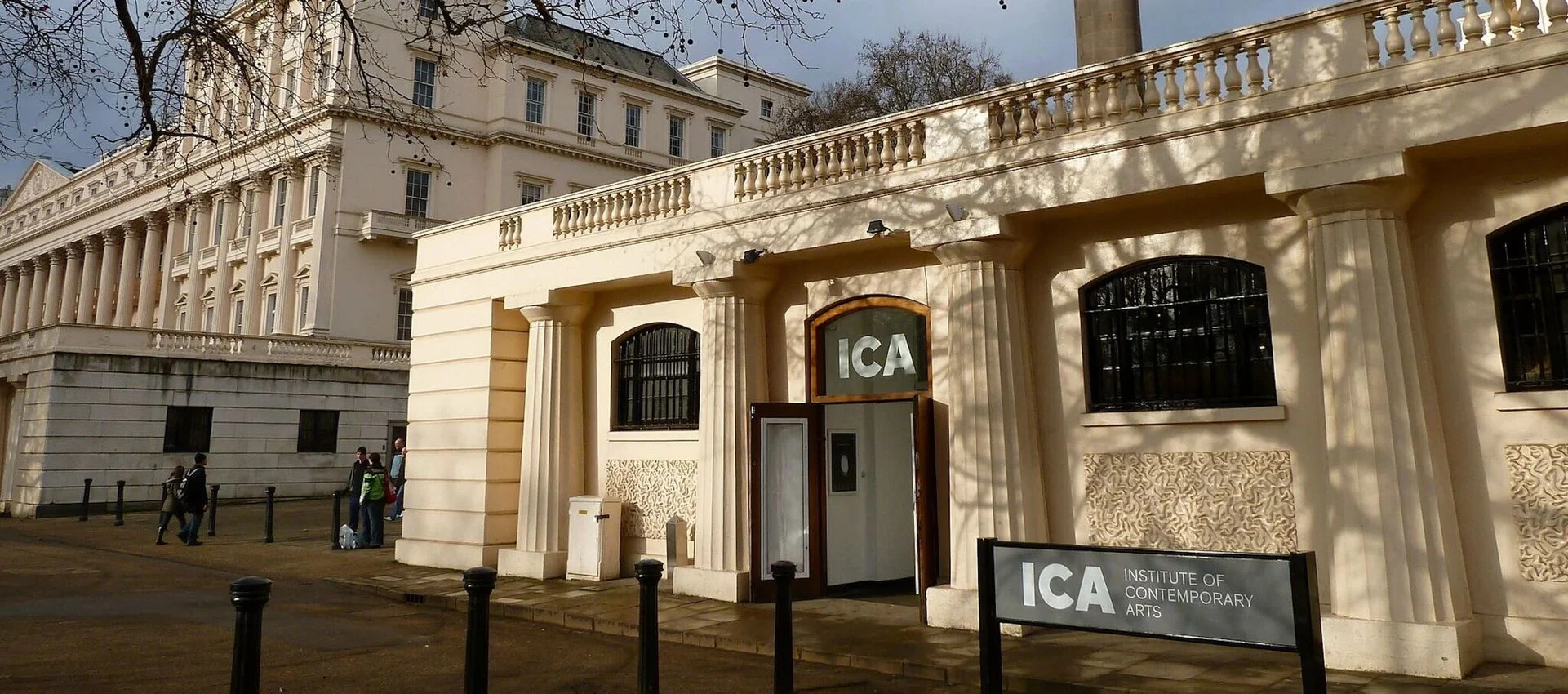
The Institute of Contemporary Arts is a leading multi-disciplinary arts centre in St.James Park, dedicated to supporting experimental, independent, and radical art and culture through exhibitions, films, performances, talks, and events. The Client's brief stated that with no centralized digital presence, ICA Creatives had no way to maintain community ties, share work, or discover ongoing studio programs. The institution needed a platform that would function as both active community hub and growing archive while meeting strict accessibility standards and aligning with ICA's commitments to the climate and to diversity.

The Challenge
How might we create a digital space that honors diasporic perspectives, supports diverse creative practices, and maintains community connections while embedding accessibility and environmental responsibility at every level?
I needed to build a visually rich platform that showcases creative work without compromising accessibility for disabled users or generating excessive carbon emissions. The solution couldn't prioritize aesthetics over function, nor could it sacrifice creative expression for technical constraints.
Research
User interviews with 8 current creatives revealed critical needs beyond basic portfolio hosting:
Community connection was the primary driver
Alumni valued peer networks more than public visibility. They wanted spaces to share process, get feedback, and discover collaborators; not just display finished work.
Existing platforms felt extractive
Instagram and Behance required constant content production and didn't support the slower, process-oriented practices taught in ICA Creatives. Artists felt pressure to perform rather than experiment.
Accessibility gaps were systemic
International students struggled with "first name/last name" fields that didn't accommodate cultural naming conventions. Non-binary participants couldn't express pronouns. Disabled artists found navigation barriers across existing creative platforms.
Competitive analysis of artist-led platforms (A.pass, Design Justice Network, DASH Arts) showed successful models prioritized flexibility in content formats, low barriers to contribution, and clear pathways between archived and active work. Failures in initial iterations came from friction in posting workflows or sterile interfaces that didn't encourage creative expression.
ICA stakeholder workshops clarified that the platform needed to serve three distinct functions: community building for alumni, inspiration and reference for current participants, and public-facing showcase demonstrating programme impact.
Early Iterations
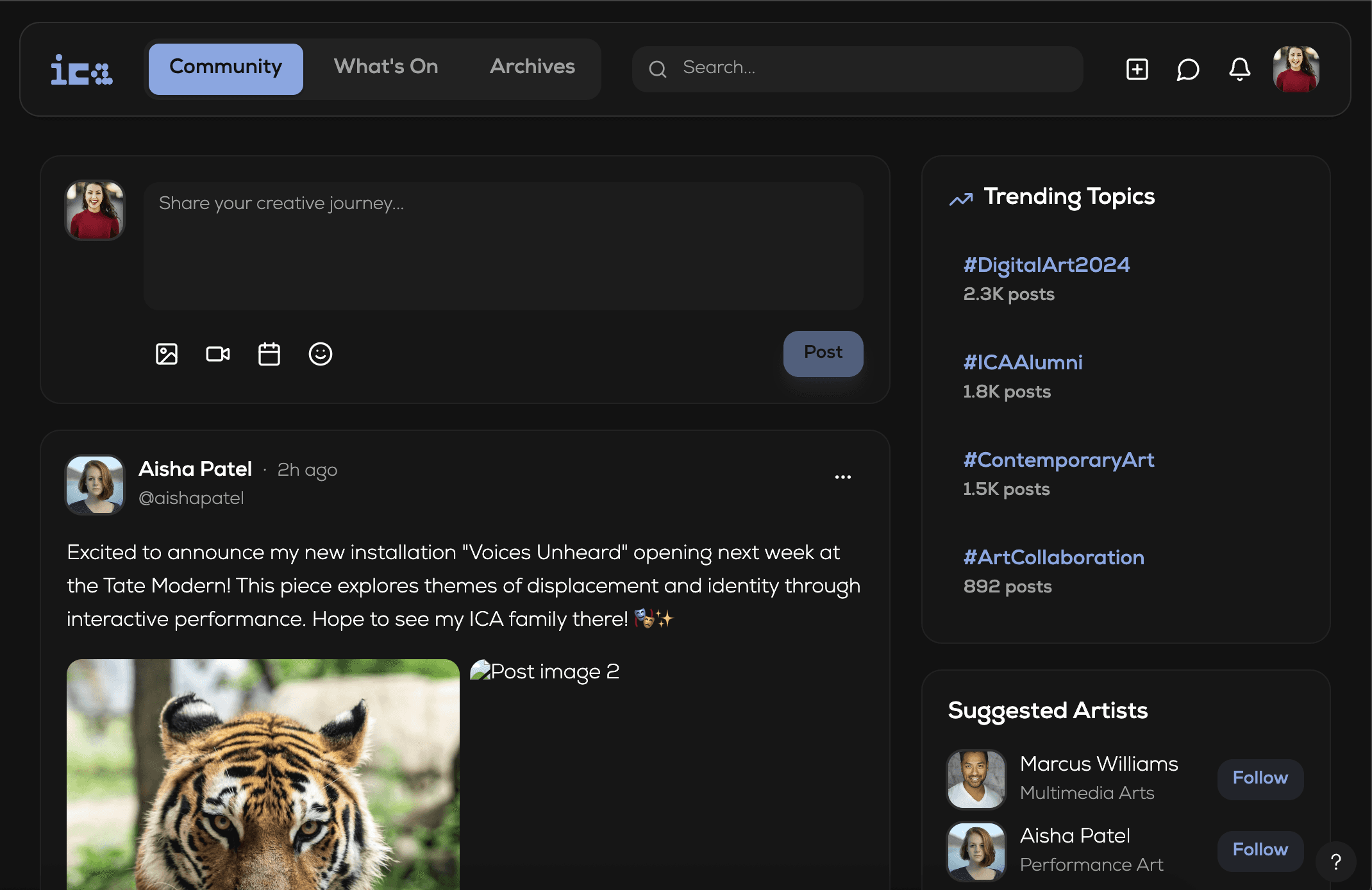
Translating Research into Navigation Design
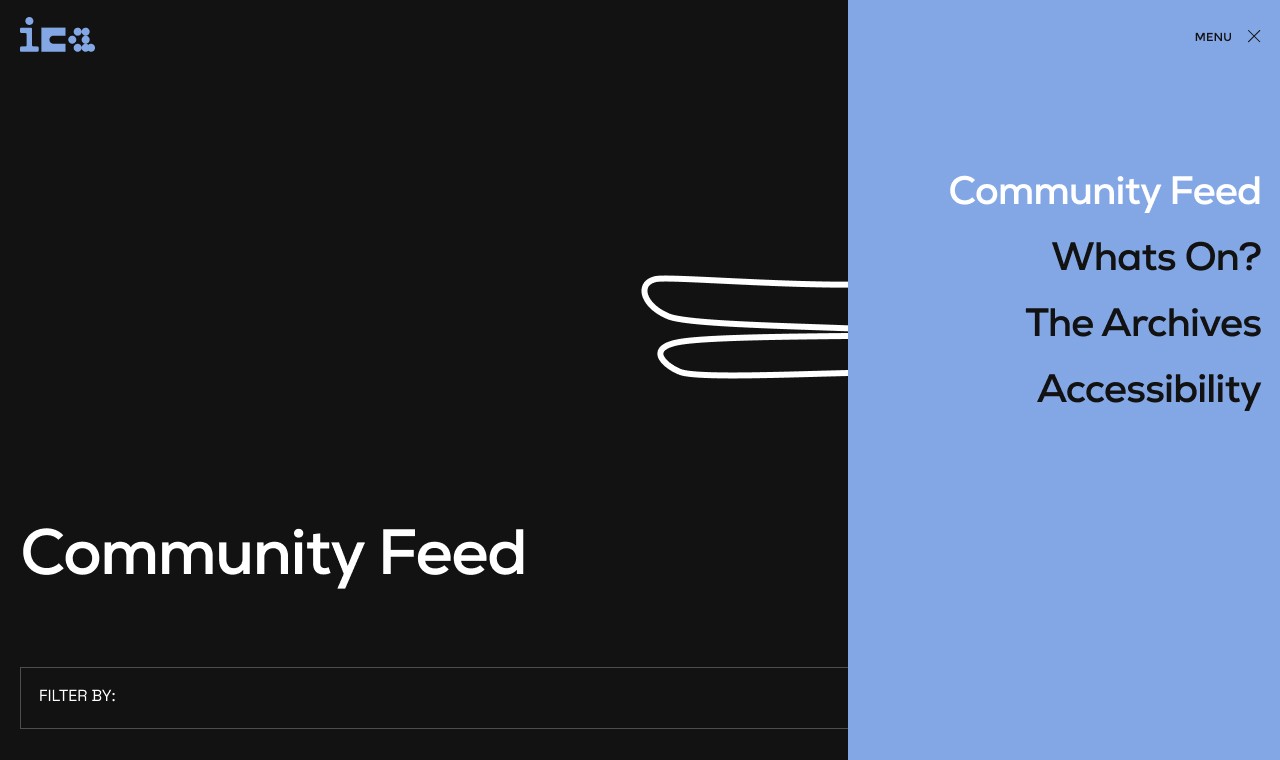
Research showed creatives frequently toggled between posting work, browsing archives, checking events, and engaging discussions often within single sessions. This required navigation that didn't force users to scroll or reload pages repeatedly.
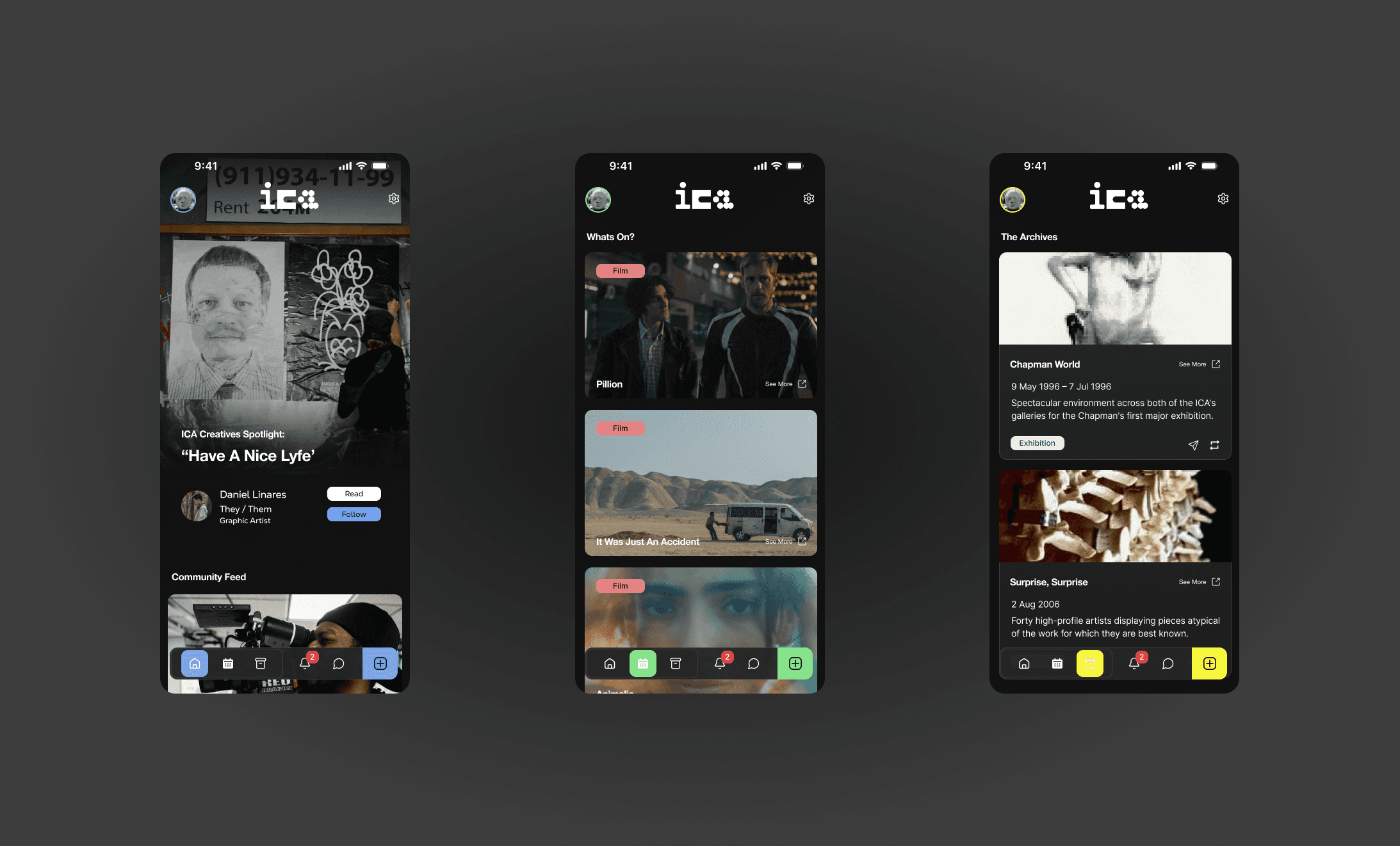
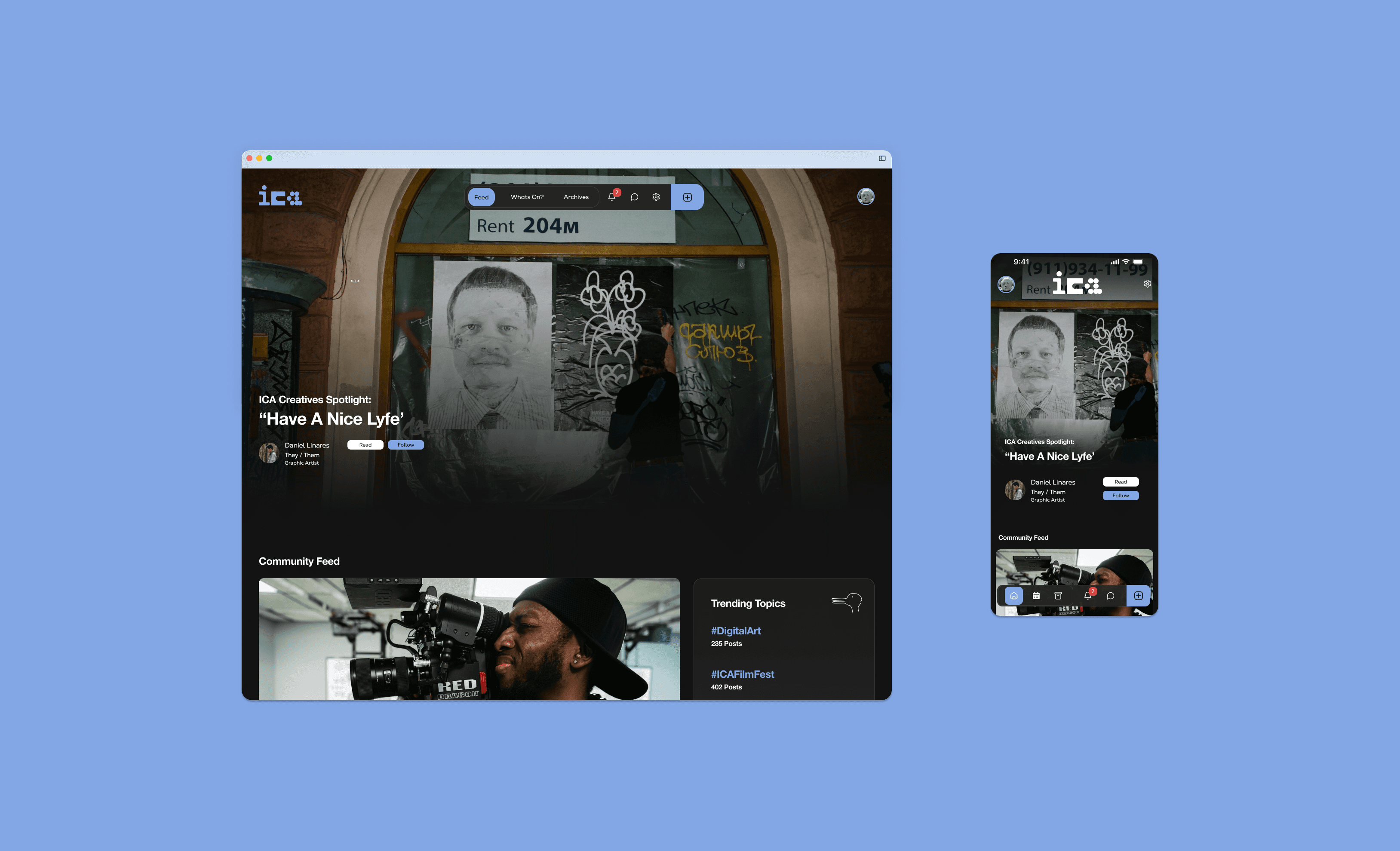
Built an island navigation system: a persistent, floating navbar accessible at any scroll depth. This solved multiple problems:
Reduced friction for disabled users
Users with motor impairments or cognitive processing differences could jump between sections without excessive scrolling or complex interactions.
Maintained spatial orientation
Fixed positioning created a consistent anchor point—critical for neurodivergent users and those using screen magnification.
Reflected ICA's modular values
Like the physical Studio's moveable partitions, the island nav provided flexible access to platform functions—aligning digital architecture with institutional values.
Keyboard-accessible via tab key with clear focus states and skip links. Lightweight implementation (simple icons, text labels, minimal CSS/JavaScript) maintained low carbon footprint while achieving full WCAG 2.1 AA compliance.
Visual Identity & Brand Consistency
Adopted ICA's existing icon system and illustration style to ensure immediate brand recognition and reduce cognitive load for users familiar with the institution. Reusing established design assets also minimized file creation, aligning with environmental sustainability goals while maintaining a cohesive digital ecosystem across ICA's platforms. Meetings with the client established that utilising colours to reflect the creative nature of the portal was a desire, it also helped user to interface synergy and brand identity simultaneously.
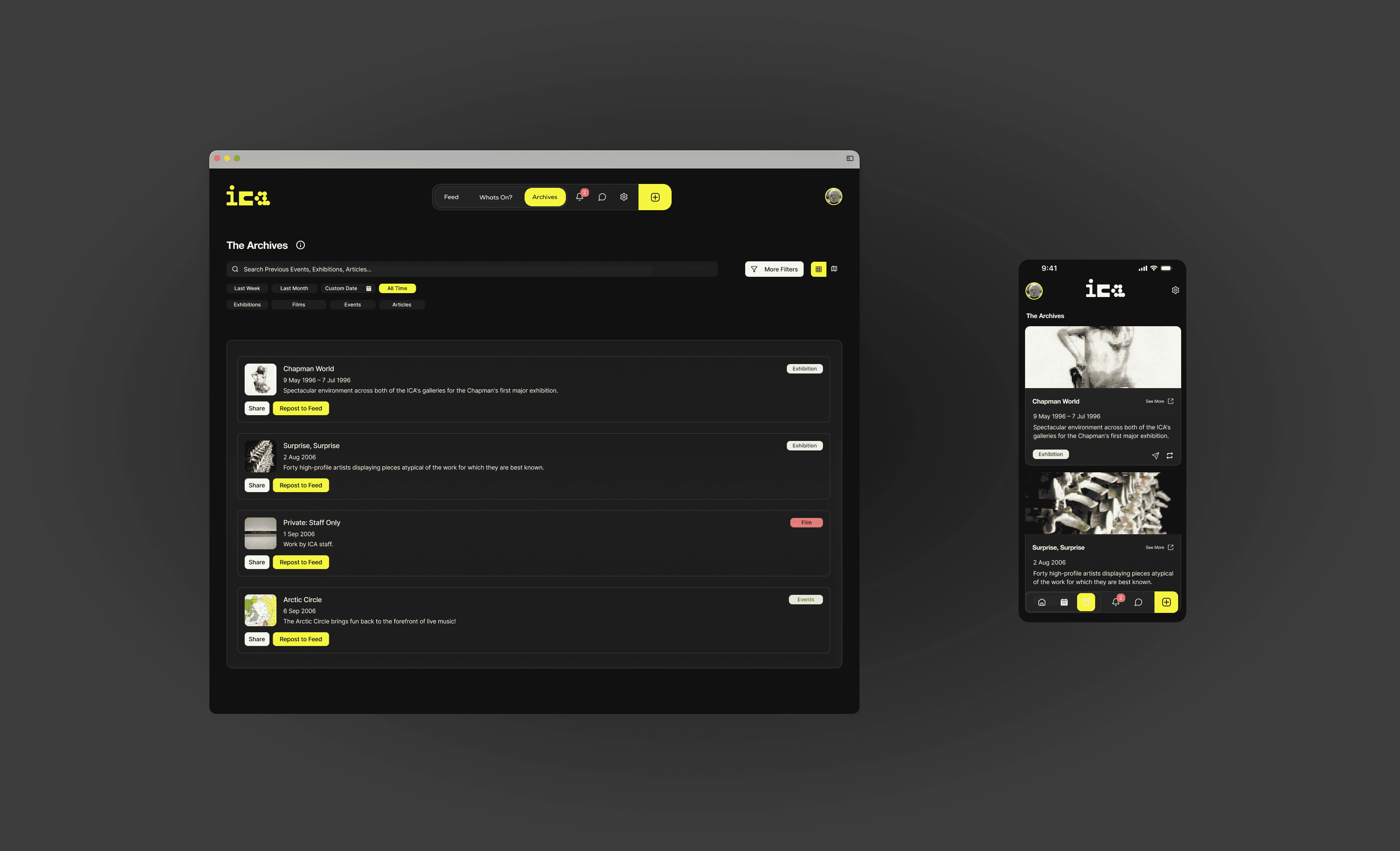
Outcomes
WCAG compliant platform serving 250+ alumni across multiple creative disciplines.
Inclusive data collection replacing extractive forms with flexible identity structures (pronoun fields, international naming, voluntary markers).
Unified content system supporting images, text, video, audio, and performance documentation through single posting interface.
40% lower carbon footprint than comparable platforms through lightweight architecture and optimized delivery.
Client approval for implementation positioning ICA to support growing alumni community and programme expansion
Modular foundation enabling future features (artist takeovers, collaborative tools, event co-creation) without structural redesign